Tips for NT Exegetical Papers at DTS

Having graded several dozen exegetical papers for NT104, and NT105, I’ve seen it all: the good, the bad, and the σκύβαλα. There is, however, a consistent set of things that I write on paper after paper, and in the hopes of improving your grades (and easing the burden on some future graders!), I offer these tips for how to make your exegeticals shine. I’ve divided them into two categories: “basics” and “advanced.”

BASICS

1. PROOFREAD!!! Even a cursory use of spell check would improve many papers (but watch out for Gentiles-Gentles, angels-angles). If English is not your native language, consider having a spouse, roommate, or friend help. But for those of us who have grown up speaking English and hold high school and university degrees, a basic level of editing for spelling and grammatical mistakes is the sine qua non of your exegetical. Note that in American English, periods and commas follow parentheses (like so). Formatting and abbreviations should follow department and SBL standards.

2. Follow directions. I can’t stress this enough: look through the grading rubric to make sure you’re doing everything asked of you. Your translation should be a free, “living” one that interprets all of the images and “Christianese.” Imagine translating the passage for those with no Christian background and with a simple literacy level. For your exegetical statement and outline, every point MUST take an adverbial subject (“The means…”). Make the headings in your commentary concise and catchy. Be sure to follow the recommended page length for each section: having outlines, word studies, and applications that are too long but a commentary that is several pages short is a sure way to earn a low grade.

3. Substantiate your claims with the proper tools. This means using lexical tools to make lexical claims, grammatical tools for grammatical points, and commentaries for broader insights. Make sure to use “cf.” when you’re citing a general point (e.g., the nature of the constative aorist) as opposed to a specific usage not given in the source (e.g., the aorist in Eph 5:24 means…).

4. Type Greek correctly. Make sure you use a Unicode font. Grave accents must be changed to acute accents when English follows (that is, at the end of a string of Greek text).

5. Significance, significance, significance. “X is the predicate nominative of Y” doesn’t really help me understand the passage any better: be careful of simply identifying morphological forms or syntactical categories. Be sure to explain the significance of anything you note. Also, make sure that your appendices (TC, word studies, and validations) state the significance of the problem for exegesis up front.

6. Use a variety of tools and reference materials. For lexical tools, use TDNT or EDNT instead of just BDAG (n.b.: BAGD is the older edition and should not be used). For grammars, go beyond ExSyn and use BDF or Robertson. And for commentaries, don’t just quote Hoehner or other conservative scholars: consider using Markus Barth’s Anchor Bible commentary, to give one example. The Bible Knowledge Commentary is NOT an acceptable resource.

7. Don’t short-circuit your validations. Make sure you evaluate the relative strengths and weaknesses of different arguments (don’t just list them). Bring up unresolved problems and surface problematic assumptions. Be thoughtful and thorough. Also, be advised that “context” is not enough of a validation: what specifically in the context are you appealing to and why?

ADVANCED:

1. Bring in backgrounds (remember NT113?). By backgrounds, I mean OT references or allusions, intertestamental or rabbinic Jewish literature, and Greco-Roman sources (especially in areas like rhetoric). Relevant archaeological data might also fit under this category.

2. Bring in secondary scholarly literature. Search New Testament Abstracts for journal articles on your passage. For NT studies, your best bet would be articles in New Testament StudiesJournal for the Study of the New TestamentJournal of Biblical Literature, and Novum Testamentum. Similarly, the library likely has several different published dissertations or volumes in major monograph series on issues related to your passage. Finally, consider monographs with a broader scope: for Ephesians or Romans, consider what James D. G. Dunn’s The Theology of Paul the Apostle has to say on the issues raised in your passage. For Romans, see also the very interesting new book by Douglas Campbell, The Deliverance of God: An Apocalyptic Rereading of Justification in Paul. Consulting the Scripture indices in the back of these books can help save you time.

3. Bring in foregrounds. The current scholarly trends emphasizing reception history should be welcomed with open arms: other centuries of Christians might after all have something worthwhile to share with us! An easy way to do this is to find the relevant volume in IVP’s Ancient Christian Commentary on Scripture series and turn to the passage you’re working on. Other series focus on medieval and Reformation-era commentary. I’m most interested in patristic-era interpretation, but the more you can show awareness that there is not an “empty gap” between the writing of the biblical text and our day, the better.

4. Beware of generalizations. “The Jews were legalistic” or “The Jews hated Gentiles” unfairly group all Jewish people into one monolithic, negative entity. This is both unfair and inaccurate. As with all people groups, there were almost certainly some that felt this way. But, at the same time, there were many (perhaps a great majority) who did not. Imagine if years from now someone wrote “All DTS students were fundamentalists.” So try to add more nuance: “Paul challenges those Jews who viewed their circumcision as…” or “Hellenization led some elements of Jewish society…” In general, try to avoid beginning a sentence with “The Jews”; if Paul does groups “the Jews” together rhetorically, go with “Paul argues that ‘the Jews’…”

Good luck!!

Posted in Seminary | Tagged , , | Leave a comment

In Layman’s Terms: “L”

In the prologue to Luke’s Gospel, the Evangelist writes, “Inasmuch as many have undertaken to compile a narrative of the things that have been accomplished among us, just as those who from the beginning were eyewitnesses and ministers of the word have delivered them to us, it seemed good to me also, having followed all things closely for some time past, to write an orderly account for you…” (Luke 1:1-3).  This verse provides explicit biblical evidence for what is an implicit characteristic of the Gospels: namely, that the Gospels are dependent on earlier sources.

Luke’s Gospel, like the others, displays a clear use of sources. Almost all NT scholars believe that Luke used Mark’s Gospel as one of his sources. The great majority of scholars believe that Luke also used a document called Q (not to be confused with the James Bond character). Q describes the material shared by Matthew and Luke that is not also found in Mark. However, a great deal of the Third Gospel is unique to Luke (that is, it is not derived from Mark or Q). The three major units of material unique to Luke are his infancy narrative, the so-called “journey to Jerusalem” (comprising much of chapters 10-19, including such famous parables of the Prodigal Son and the Good Samaritan), and the Lukan resurrection appearances. Because of special issues involved with the infancy and resurrection materials, when scholars speak of “L” they most often refer to the stories of Jesus’ earthly ministry that are unique to Luke’s Gospel.

There are as many theories about the origin and character of “L” as there are biblical scholars. Like its Matthean counterpart (“M,” also not a 007 character), this source has received considerably less attention than the notorious Q. But there do appear to be enough similarities within the L material (and enough sufficient differences from Luke’s redaction of Mark and Q) to posit a single source. For a couple good works on this issue, see Kim Paffenroth, The Story of Jesus according to L, JSNTSupp 147 (Sheffield: Sheffield Academic Press, 1997) and D. M. Parrott, “The Dishonest Steward (Luke 16.1-8a) and Luke’s Special Parable Collection,” NTS 37 (1991): 499-515.

So what is “L”? As a result of my research, I currently hold a view similar to Mark Goodacre’s: the combination of both non-Lukan and Lukan features in some of the L tradition suggests that Luke has reworked an existing source (likely oral tradition circulating in Palestine) to add his own distinctive touch. And this original “L” source, I contend, contained an early version of the pericope adulterae.

Posted in New Testament | Tagged , , , | 4 Comments

In Layman’s Terms: The Pericope Adulterae

The term “pericope adulterae” may be unfamiliar to some, but it’s simply a traditional way of referring to the story of Jesus and the woman caught in adultery (John 7:53-8:11). This brief story (or “pericope”) has a unique and complex history shrouded in a fair amount of mystery – as far as biblical studies go, it’s a real puzzle. As almost every Bible translation notes before or after John 7:53-8:11, “our earliest and best manuscripts do not contain John 7:53-8:11.” Indeed, Codex Bezae (5th c.) is the first manuscript of John’s Gospel to contain this story, which the majority of copies of John’s Gospels have followed, to this day. To complicate matters, other, later manuscripts place the pericope after John 7:36, John 21:25, and Luke 21:38. The only comparable textual problem of this magnitude in the NT is the so-called “longer ending(s) of Mark” (16:9-20). So what do we make of this?

Almost all scholars agree that John 7:53-8:11 is not original to John’s Gospel: apart from the manuscript evidence, the story interrupts John’s narrative and features lots of non-Johannine language. Yet many scholars believe that the story does represent a (more or less) real event in the life of the historical Jesus. The story does exist in different forms prior to the fifth century. More than 20 years ago, Bart Ehrman’s article “Jesus and the Adulteress,” NTS 34 (1988): 24–44 argued that the form of the story that ended up in Codex Bezae was in fact a conflation of two earlier stories involving Jesus and a sinful woman. These earlier forms were likely in touch with an early tradition – but how much earlier? My article argues that the most important of these earlier forms can in fact be traced back to the first century, significantly increasing the odds that the majority of the pericope adulterae goes back to early oral tradition.

Why, though, was this story eventually placed after John 7:52? In a recent book (The Pericope Adulterae, the Gospel of John, and the Literacy of Jesus, NTTSD 38; Leiden: Brill, 2009), Chris Keith has argued that this story, perhaps the only one in the Jesus tradition that shows Jesus writing (on the ground), was included in the Gospels to counter the claims of critics who charged that Jesus was illiterate and therefore unworthy of honor or worship. The pericope’s subsequent dislocation to other places in the Gospels can reasonably be explained by the influence of the lectionary system in combination with the confusion resulting from the story’s late addition to the Gospel of John. It’s impossible to say, but it seems to me that Keith’s explanation is the best advanced thus far.

Posted in New Testament | Tagged , , , | 4 Comments

Update: NovT to publish my article on the PA

I’ve just received some very exciting news: the journal Novum Testamentum has accepted my article, “The Lukan Special Material and the Tradition History of the Pericope Adulterae,” for publication. This article, which grew out of my work in Dan Wallace’s Textual Criticism and Advanced Greek Grammar classes, argues that the most significant early form of the story of Jesus and the woman caught in adultery was likely associated with the body of tradition unique to Luke’s Gospel. More updates and discussion on this topic as publication draws near!

Update 11/21: NovT has informed me that the article should appear in the second quarter of 2013.

Posted in Uncategorized | Tagged , , , | Leave a comment

Welcome!

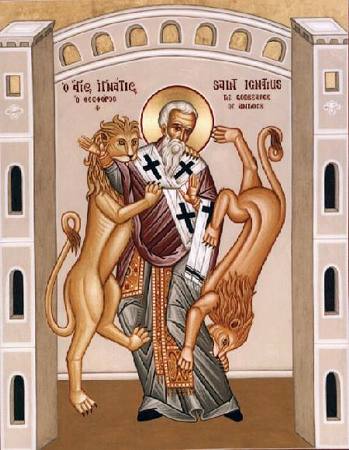
In his letter to the church at Philadelphia, Ignatius, the bishop of Antioch in the early second century, recounts the following exchange with some opponents: “For I heard some people saying, ‘If I do not find it in the archives [τοῖς ἀρχειοῖς] I do not believe it in the gospel.’ And when I said to them, ‘It is written,’ they answered me, ‘That is the point at issue.’ But to me the archives [τὰ ἀρχεῖα] are Jesus Christ, the inviolable archives [τὰ ἀρχεῖα] are his cross and death and his resurrection and the faith that is through him” (Ign. Phil. 8.2).

Most scholars understand τὰ ἀρχεῖα to refer to the Hebrew (or Old Testament) Scriptures. As such, this passage provides a glimpse into early Christian attempts to make sense of the sacred texts of Judaism in light of the Christ event. I like this passage because it highlights my interest in how early Christian hermeneutics: that is, how the first Christians read, referenced, and reinterpreted Scriptural texts. I am interested in this reception of the biblical texts and how the study of this Wirkungsgeschichte (“working history”) can connect and illuminate other areas of study such as textual criticism, narrative criticism, and biblical theology.

This blog, I hope, will help keep you (my family and friends) updated on my interests (without you having to actually read any lengthy monographs or dense journal articles!) and developments concerning my doctoral applications and academic publication. Stay tuned!

Posted in Uncategorized | Leave a comment