Note: As a service to fellow researchers, I am going to post critical biographies of the church fathers I examined in my book The Trinitarian Testimony of the Spirit. These biographical overviews were included in my original dissertation but were cut from the published version. Original footnotes are included as endnotes below; in conjunction with the essential bibliographies I have posted, this should help those looking to get into the literature on the early church fathers. I have been struck by how many published sources read the primary sources with a fairly uncritical lens; in these summaries, like any good historian, refuse to take primary sources at face value.
Tertullian: A Critical Biography
As with Irenaeus, much of Tertullian’s life is cloaked in mystery. While ancient sources give a fair amount of details concerning the life of Tertullian, modern scholars have judged these to be largely unreliable for reconstructing his biography.[1] Among the ancient sources, the most complete account of the life of Tertullian is provided by Jerome in his On Illustrious Men. In this work, written in Bethlehem ca. 392 or 393 CE, Jerome provides a brief biographical sketch of Tertullian, noting that he was born to a proconsular centurion (centurio proconsularis) and became a priest and a prolific writer in the African city of Carthage during the reigns of Severus (193–211 CE) and Caracalla (198–217 CE). It was at some time in this period, Jerome asserts, that Tertullian lapsed into Montanism, a heresy which brought him into conflict with the catholics until his death in old age.[2] Eusebius, for his part, portrays Tertullian as an expert in Roman law, and in fact one of the most distinguished jurists in all of Rome.[3] Beginning with the groundbreaking work of Timothy Barnes, however, most scholars have come to accept that most of these details are likely false, and as such we must begin by deconstructing these elements of the traditional portrayal of the life of Quintus Septimius Florens Tertullianus.[4]
While Jerome seems to have the date and location of Tertullian’s ministry correct, the other aspects of his account of Tertullian’s early life are at best speculation or at worst contradictory to Tertullian’s own statements.[5] In Jerome’s favor, the frequent, familiar references to Carthage in Tertullian’s extant writings demonstrate that he indeed spent the height of his literary career in that city,[6] and Barnes’s dating of Tertullian’s extant works to the period 196 to 212 CE confirms Jerome’s identification of the reigns of Severus and Caracalla as the peak of Tertullian’s literary production.[7] Beyond this, things become more problematic. For instance, Jerome’s claim that Tertullian was the son of a Roman centurion appears to have been an incorrect deduction based on a textual corruption.[8] Likewise, Jerome’s insistence that Tertullian was a priest is contradicted by Tertullian’s own claim that he was a member of the laity,[9] and his contention that Tertullian made a decisive break from the catholic church is increasingly met with scholarly skepticism (see below). Eusebius’s claim that Tertullian was a famous Roman jurist has also been disproven, with Eusebius likely having conflated our Tertullian with a famous Roman jurist by the same name.[10] As a result of this deconstruction, the most scholars can now say with confidence concerning Tertullian’s early life is that he was born to a non-Christian family ca. 160–170 CE,[11] was highly educated and thus a member of the Carthaginian elite, and was married.[12]
Much more, thankfully, is known about the city of Carthage and the early Christian movement there, allowing us to set Tertullian and his writings into historical context. After being razed by the Romans in 146 BCE following the conclusion of the Punic Wars, Carthage was rebuilt by Caesar Augustus, becoming by Tertullian’s day the largest and most prosperous city in the western half of the empire with the exception of Rome itself.[13] Whatever the origins of Christianity in North Africa, Christianity quickly spread, presumably from Carthage, across the cities of North Africa. [14] Over time, the Christians of North Africa came to develop distinctive beliefs and rituals,[15] and it is in this context that we can best understand Tertullian.[16]
Our first tangible glimpse into the Carthaginian church comes through surviving martyrdom accounts that illuminate the distinctive nature of African Christianity. In the Acts of the Scillitan Martyrs (180 CE), twelve commoners from the nearby village of Scilli are brought before the Roman governor in Carthage and interrogated concerning their Christian beliefs.[17] When they refuse to offer devotion to the emperor’s genius, the governor has them beheaded. Likewise, in The Passion of Saints Perpetua and Felicity (203 CE), we have the record of several Carthaginians who were arrested on account of their profession of faith in Christ. This group cuts across social classes, encompassing both slaves and the nobly born Vibia Perpetua, whose prison diary makes up most of the text; all are martyred before a great crowd in the city’s amphitheater.[18] These accounts testify to the eagerness for martyrdom among Christians in North Africa as well as the existence of at least sporadic, local persecutions that gave rise to these martyrdoms.[19] The latter text is also of particular importance as scholars have found within it evidence of Montanism, the same theological movement with which Jerome had associated Tertullian and his purported break from the catholic church.[20]
Montanism, an anachronistic term for the religious movement better known in Tertullian’s day as the New Prophecy,[21] exploded out of Phrygia ca. 165 CE under the leadership of Montanus, whose ecstatic prophecies (along with those of his two female companions, Priscilla and Maximilla) gave birth to what William Tabbernee characterizes as “a prophetic renewal movement informed by the Holy Spirit.”[22] This movement was charismatic, insofar as its adherents claimed to be inspired by the Paraclete, rigorous, insofar as its members rejected the notion of penitence for post-baptismal sin and insisted on an ascetic lifestyle, and possibly also chiliastic, insofar as its followers may have awaited the arrival of the heavenly Jerusalem and the millennial reign of Christ on the earth.[23] Despite earning the condemnation of the Asian churches, the Montanist movement won adherents throughout Asia Minor and beyond;[24] eventually, the New Prophecy reached Carthage and began to spread across North Africa.[25]
This brings us, finally, back to Jerome’s biography of Tertullian. Jerome seems to suggest that Tertullian made a decisive break from the catholic church, joining with a distinct Montanist sect and launching rhetorical assaults on his former co-religionists. While Tertullian’s writings do indeed show evidence of a deepening attraction to the teachings of the New Prophecy (see below), Jerome again has likely read too much into the life of Tertullian. Simply because Tertullian’s writings are heavily influenced by the New Prophecy, there is no concrete evidence that he actually left the catholic church or formally joined a schismatic group identical to that which was later termed “Montanism.” Instead, there could have been considerable diversity in the beliefs and practices of the Carthaginian Christians without there having been a formal rupture of communion.[26] Tertullian, therefore, very likely saw himself not as a member of a schismatic movement but as a loyal, “orthodox” member of the catholic church; he was, perhaps, a member of a group within the church that had some heated disagreements with others within the church who were less rigorous about their faith and practice, his so-called psychici.[27] As such, as Christine Trevett has aptly put it, “Tertullian the Montanist was Tertullian the Montanist catholic.”[28] Assuming Augustine’s claim that Tertullian later left the Montanists to form a still more rigorous sect to be apocryphal,[29] little is known about Tertullian’s later life or the date of his death, though Barnes’s suggestion that Tertullian died, potentially as a martyr, shortly after completing the last of his extant works (ca. 212 CE) seems plausible.[30]
A final important aspect of Tertullian’s life concerns the extent to which he had access to other early Christian writings. Scholars have little doubt that he had access to the writings of both Justin[31] and Irenaeus;[32] the extent to which either may have influenced Tertullian’s notions of the Trinitarian testimony of the Spirit will be explored and validated in more detail later in this chapter. As for the New Testament, Tertullian cites every book except James, 2 Peter, and 2 and 3 John.[33] It appears that he often made his own translations from the Greek, although on occasion he may have relied on some pre-existing Latin translations.[34]
[1] For older works that mostly follow Jerome for their reconstruction of Tertullian’s life, see, e.g., Otto Bardenhewer, Patrologie, 2nd ed. (Freiburg: Herdersche, 1901), 157; Johannes Quasten, Patrology, 3 vols. (Utrecht: Spectrum, 1950–1960), 2:246–48. Despite this shift among scholars studying Tertullian, many more general contemporary works continue to rely heavily on the patristic sources for their summary of the life of Tertullian; see, e.g., François Decret, Early Christianity in North Africa, trans. Edward L. Smither (Eugene, OR: Cascade, 2009), 33–41; Philippe Henne, Tertullien l’Africain (Paris: Cerf, 2011), 29–41, 49–53. Though not inclusive of modern works, Gerald Bray, Holiness and the Will of God: Perspectives on the Theology of Tertullian (Atlanta: John Knox, 1979), 8–31, gives an excellent overview of the history of scholarship concerning Tertullian.
[2] Vir. ill. 53 (PL 23:698). For translation, see Timothy David Barnes, Tertullian: A Literary and Historical Study (Oxford: Clarendon, 1971), 3.
[3] Hist. eccl. 2.2 (SC 31:53). Eusebius also cites Tertullian at Hist. eccl. 2.25, 3.20, 3.33, 5.5 (SC 31:92, 124, 146; SC 41:30–31).
[4] For modern, critical reconstructions of the life of Tertullian, see Barnes, Tertullian, 1–29; Bray, Holiness, 32–65; Heinrike Maria Zilling, Tertullian: Untertan Gottes und der Kaisers (Paderborn: Schöningh, 2004), 21–82; David E. Wilhite, Tertullian the African: An Anthropological Reading of Tertullian’s Context and Identities, Millennium-Studien 14 (Berlin: De Gruyter, 2007), 17–27. On Tertullian’s full name, see further Barnes, Tertullian, 242–43; Wilhite, Tertullian, 18.
[5] As Henne (Tertullien, 30) cautions, “Jérôme est plus que partial dans ses jugements: il y a les Pères qu’il aime et ceux qu’il n’aime pas, et cela influence très fort sa rédaction.” Despite this warning, Henne’s biography of Tertullian is largely uncritical with respect to the information provided by Jerome and Augustine.
[6] Barnes, Tertullian, 10; see further the list of specific references in Geoffrey D. Dunn, Tertullian, ECF (London: Routledge, 2004), 4.
[7] Barnes, Tertullian, 30–56.
[8] Barnes, Tertullian, 11–21; Wilhite, Tertullian, 19. The first problem with Jerome’s claim is that the rank centurio proconsularis did not, to our best knowledge, exist in the Roman army; the second is that child sacrifice had mostly vanished from North Africa by Tertullian’s day. Thus, the key text of Apol. 9.2 (CCSL 1:102) should be emended from patri nostri to patri nostrae. See, however, the dissenting opinions of James B. Rives, “Tertullian on Child Sacrifice,” MH 51 (1994): 54–63; Henne, Tertullien, 32; Zilling, Tertullian, 30.
[9] Barnes, Tertullian, 11; Wilhite, Tertullian, 24; cf. Exh. cast. 7.3 (SC 319:92); Mon. 12.2 (CCSL 2:1247).
[10] Barnes, Tertullian, 22–29; Wilhite, Tertullian, 20–23. The question of Tertullian’s training and profession is, however, more complicated. The current consensus is that Tertullian was not even a professional lawyer in the first place; cf. David I. Rankin, “Was Tertullian a Jurist?,” SP 31 (1997): 335–42. Instead, Tertullian is often portrayed as a professional sophist (cf. Barnes, Tertullian, 211–32), though some scholars maintain that Tertullian did indeed receive some training as an advocate (cf. Zilling, Tertullian, 33–36; albeit less certainly, Rankin, “Was Tertullian a Jurist?,” 342). Eric Osborn, Tertullian: First Theologian of the West (Cambridge: Cambridge University Press, 1997), 27–47, claims that Tertullian was in fact a philosopher, but this view appears not to have caught on with other scholars. For an overview of the status quaestionis, see Wilhite, Tertullian, 20–23.
[11] While many scholars have followed Jerome in assuming that Tertullian’s work is that of a mature, older writer, thus suggesting a birth date ca. 155 CE, Barnes (Tertullian, 58) insists that “nothing forbids the hypothesis that Tertullian was born c. 170.” Indeed, Tertullian’s writings give us no clue as to his date of birth or his age when he wrote them.
[12] Dunn, Tertullian, 4–5. Thus the statement of Bray (Holiness, 9) that “in the end all we can really say about Tertullian’s life is that we know virtually nothing about it” is a slight exaggeration. Tertullian in Ux. 1.1.1 (CCSL 1:373) records that he was married to a Christian, though in Res. 59.3 (CCSL 2:1007) he appears to indicate that he had at some point committed adultery.
[13] Thus Herodian, Hist. 7.6.1 (LCL 455:190). On historical background related to the city of Carthage, see further Decret, Early Christianity in North Africa, 1–8; Henne, Tertullien, 13–18; Zilling, Tertullian, 61–82.
[14] The first reference to Christianity in Roman Africa is probably found in Apuleius’s Metamorphoses (mid-to-late second century CE). When exactly Christianity was brought to North Africa, and by whom, is the subject of much speculation. For overviews of the scholarly inquiry into the origins and spread of Christianity in North Africa, see Wilhite, Tertullian, 31–35; Decret, Early Christianity in North Africa, 10–16; Dunn, Tertullian, 13–15; J. Patout Burns Jr. and Robin M. Jensen, Christianity in Roman Africa: The Development of Its Practices and Beliefs (Grand Rapids: Eerdmans, 2014), 1–6; David Rankin, Tertullian and the Church (Cambridge: Cambridge University Press, 1995), 10–16.
[15] Decret, Early Christianity in North Africa, 17–23, 28–32; Burns and Jensen, Christianity in Roman Africa, 165–621.
[16] As Decret (Early Christianity in North Africa, 34) elegantly puts it: “Through his genius and weaknesses, boldness in the midst of battles, revolt in the face of injustices, excesses, affinity for provocation, preference for paradox, quibbling spirit, and appetite for brilliant and subtle formulas, Tertullian represented an entire people.”
[17] Decret (Early Christianity in North Africa, 10) notes the “remarkable” fact that the names of some of these martyrs were African, whereas the Gallican martyrs were Greek-speaking immigrants from Asia and Phrygia.
[18] For more on the church at Carthage in the time of Tertullian, see Rankin, Tertullian and the Church, 17–20; Henne, Tertullien, 19–28.
[19] For an overview of these texts, see Dunn, Tertullian, 15–17; Decret, Early Christianity in North Africa, 9–10, 23–26. For a recent introduction to these martyrdom accounts from a conservative perspective, see Bryan M. Litfin, Early Christian Martyr Stories: An Evangelical Introduction with New Translations (Grand Rapids: Baker Academic, 2014), 87–109. Recently, Candida Moss, The Myth of Persecution: How Early Christians Invented a Story of Martyrdom (New York: HarperOne, 2013) has argued that Tertullian and other early Christian apologists have widely overstated the extent of early Christian persecution and has criticized early Christian martyr stories as “exciting, interesting, and completely untrue” (85), but even accepting a large degree of literary license does not require rejecting the historicity of the event itself. For a mediating position that takes the Christian sources seriously and critically, see Burns and Jensen, Early Christianity in Roman Africa, 7–26.
[20] Barnes, Tertullian, 77–79; Rankin, Tertullian and the Church, 13–14.
[21] For this reason, I prefer to speak of Tertullian’s support of “the New Prophecy” rather than of “Montanism,” though following convention I will occasionally use “Montanism” as an imperfect shorthand for the same phenomenon.
[22] William Tabbernee, Montanist Inscriptions and Testimonia: Epigraphic Sources Illustrating the History of Montanism, NAPSPMS 16 (Macon, GA: Mercer University Press, 1997), 24. The standard reference work on Montanism is now Christine Trevett, Montanism: Gender, Authority and the New Prophecy (Cambridge: Cambridge University Press, 1996), emphasizing how the condemnation of Montanism likely stemmed from controversy over the nature of authority, with Montanism’s promotion of direct revelation threatening established church leadership. On Montanus and the emergence of the New Prophecy in Phrygia, see further ibid., 26–45, 77–86. Alistair Stewart-Sykes, “The Original Condemnation of Asian Montanism,” JEH 50 (1999): 1–22, is a further helpful introduction, instead tracing the eventual condemnation of Montanism to its rural roots.
[23] For more on the teachings of the Montanists, see Trevett, Montanism, 86–150. Whether a fervent millennialism was also a defining feature of the movement is a subject of some scholarly debate; see Trevett, Montanism, 95–105; Charles E. Hill, Regnum Caelorum: Patterns of Millennial Thought in Early Christianity, 2nd ed. (Grand Rapids: Eerdmans, 2001), 143–59.
[24] On the spread of Montanism and the sources available to historians, see further Trevett, Montanism, 46–66. On epigraphic sources, see Tabbernee, Montanist Inscriptions and Testimonia. For other important ancient sources for the study of Montanism, see Ronald E. Heine, The Montanist Oracles and Testimonia, NAPSPMS 14 (Macon, GA: Mercer University Press, 1989). See also the speculative narrative of William Tabbernee, Prophets and Gravestones: An Imaginative History of Montanists and Other Early Christians (Peabody, MA: Hendrickson, 2009).
[25] On the arrival and spread of Montanism in North Africa, see Trevett, Montanism, 69–72; Decret, Early Christianity in North Africa, 37–41; Rankin, Tertullian and the Church, 43–51.
[26] See further the thorough defense of this position in Rankin, Tertullian and the Church, 27–40; cf. Dunn, Tertullian, 6–7; Trevett, Montanism, 68–69; Zilling, Tertullian, 51–53; Douglas Powell, “Tertullianists and Cataphrygians,” VC 29 (1975): 33–54, esp. 33–38. There seems, therefore, to be little warrant for Henne’s claim that in Carthage ca. 210 “les montanistes avaient peu à peu créé leur propre liturgie, leur propre clergé, bien distincts de ceux des autres communautés” (Tertullien, 53).
[27] A modern minority position holds that Tertullian was not even a member of a sub-group within the church at Carthage, as suggested by the majority view described here; cf. David E. Wilhite, “The Spirit of Prophecy: Tertullian’s Pauline Pneumatology,” in Todd D. Still and David E. Wilhite, Tertullian and Paul, vol. 1 of Pauline and Patristic Scholars in Debate (New York: Bloomsbury T&T Clark, 2013), 48.
[28] Trevett, Montanism, 69.
[29] Haer. 86 (PL 42:46–47); cf. Barnes, Tertullian, 258–59; Rankin, Tertullian and the Church, 37; contra Henne, Tertullien, 53. The term “Tertullianists,” used by Augustine to describe the Montanists with whom he was familiar, was likely simply the name given to African Montanists (as distinguished from those in Phrygia), and thus Augustine is perhaps “producing the confused explanation of an authentic tradition” (so Powell, “Tertullianists and Cataphrygians,” 53; cf. Zilling, Tertullian, 54–56).
[30] Barnes, Tertullian, 59.
[31] Ernest Evans, ed. and trans., Tertullian’s Treatise against Praxeas: The Text Edited, with an Introduction, Translation, and Commentary (London: SPCK, 1948; repr., Eugene, OR: Wipf & Stock, 2011), 31, claims that Tertullian “reproduces [Justin’s expositions] without the tentativeness and reserve which were natural to that gentler mind.” Tertullian’s debt to Justin is perhaps best evidenced in his Adv. Jud. and Apol. Tertullian references Justin explicitly as a source for his anti-Gnostic polemic in Val. 5.1 (CCSL 2:756).
[32] Barnes, Tertullian, 221. Tertullian also references Irenaeus as a source for his anti-Gnostic polemic in Val. 5.1 (CCSL 2:756). See further J. H. Waszink, “Tertullian’s Principles and Methods of Exegesis,” in Early Christian Literature and the Classical Intellectual Tradition: In Honorem Robert M. Grant, ed. William R. Schoedel and Robert L. Wilken, ThH 53 (Paris: Beauchesne, 1979), 17–31, here 21. Val. and Praesc. are generally cited as the two works of Tertullian which draw most extensively on Irenaeus.
[33] Bruce M. Metzger, The Canon of the New Testament: Its Origin, Development, and Significance (Oxford: Clarendon, 1987), 160. Dunn (Tertullian, 19) lists only 2 and 3 John as excluded from Tertullian’s writings.
[34] Dunn, Tertullian, 20–21.
 In his new book, Salvation by Allegiance Alone, Matthew Bates argues that Christians “should entirely cease to speak of ‘salvation by faith’ or of ‘faith in Jesus’ or of ‘believing in Christ’ when summarizing Christian salvation” (3). In fact, he proposes nothing less than “to rethink the gospel, faith, and salvation” (8). And, to boot, Bates suggests that his book “will ultimately contribute to the healing of that long-festering wound between Catholics and Protestants” (6). Most books that make such ambitious, even grandiose, claims inevitably disappoint readers hoping for something truly insightful and meaningful. Bates, however, actually delivers on his promise, penning a work that is, at once, sharply erudite, richly theological, and deeply pastoral.
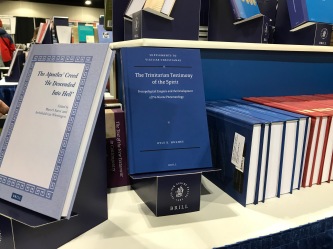 With SBL Denver now behind me, it’s a good moment to pause and reflect on the year that has passed and look forward to the year ahead. Without a doubt, this was one of my most active years to date: a monograph (The Trinitarian Testimony of the Spirit, from Brill), a journal article (on Cyprian, in the Journal of Early Christian History), a book review (in Review of Biblical Literature) and three conference presentations (on the Epistle of Barnabas and on Irenaeus at SBL Helsinki; on second-century Christology at SBL Denver). Still, the highlight of the year, academically speaking, was the opportunity to attend these conferences where I could both reconnect with old friends and meet new people, especially current graduate students, who are excited about my work and seem eager to take it in new directions.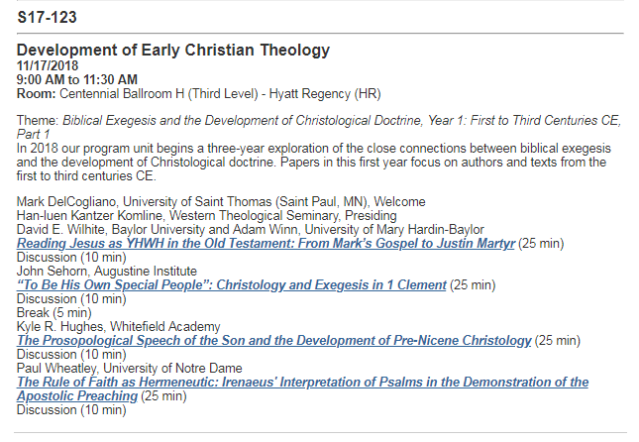
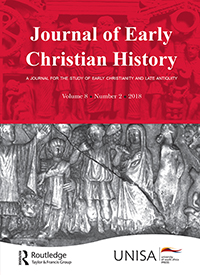 I’m excited to share that I have a new article available in the Journal of Early Christian History. This article was in part spun out of my book The Trinitarian Testimony of the Spirit to provide some categories and clarity for thinking about the different ways in which the Holy Spirit relates to the words of the Old Testament, as presented in early Christian writings.
 I’ve just returned from the 2018 SBL IM in Helsinki, where I presented two papers on early Christian pneumatology (one on the Epistle of Barnabas and one on Irenaeus). Despite the heat wave pummeling Finland along with the rest of Europe (oddly, the saunas still seemed wildly popular despite every non-air conditioned environment (read: everywhere) itself feeling like a sauna, Helsinki was a wonderful city to visit: beautiful, clean, welcoming. Expensive, too, but that’s par for the course in the Nordic countries.


 Kyle R. Hughes