
 This week in class, I was told in no uncertain terms that when teaching and preaching from the OT, it is invalid to read in NT theology. Though this is not necessarily an uncommon thing to hear in these parts, I raised my hand and protested that this would, in effect, put us at odds with how all of the early church fathers, not to mention Paul and other NT writers, read and interpreted the OT. The response to this was simply “the fathers are wrong,” on account of the fact that we have a better hermeneutic than they did.
Apart from the arrogance in shrugging off the weight of history and tradition (that is, if a certain interpretive method was indeed near-universal among the apostles and their students, then just maybe there might be something to be said for it?), this classically illustrates the need for a different approach to reading the Bible, one that is, above all, distinctively Christian and therefore Christocentric in its entirety.
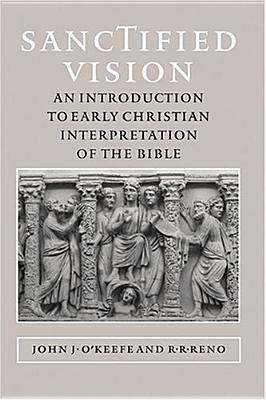
Along these lines, I’m currently reading O’Keefe & Reno, Sanctified Vision: An Introduction to Early Christian Interpretation of the Bible (Baltimore: Johns Hopkins University Press, 2005). The authors aim to explain the structure and logic of early Christians’ biblical interpretation. Of course, for the fathers, “the Bible” was primarily the (Greek) OT, as the NT writing would not be canonized as such for some time.
The authors start by confessing their initial prejudice towards patristic interpretation and trace their journey towards the following conclusion: “We were incapable of reading the church fathers because of our own assumptions about how the Bible ought to be read. Our assumptions about what is meant by literal and spiritual, as well as our notions about the relationship between doctrine and scripture, made the church fathers seem disorganized, ineffective, and even contradictory. […] For us, then, the first step toward understanding patristic exegesis was a moment of self-criticism. We began to realize that it might be our anachronistic assumptions about the meaning of the terms literal and spiritual that made the fathers seem obscure, not some defect in their interpretive assumptions” (6-7).
In the first chapter, the authors go on to unpack one of the key differences between patristic and modern readings of Scripture: the nature of meaning itself. Whereas modern readers tend to assume a correspondence or referential view of meaning (“The Bible is significant because it refers to important truths, namely facts, events, ideas, and experiences”), whereas, for the fathers, the text is the subject matter (“The Bible is significant by virtue of being scripture”). “Scripture was, for them, the orienting, luminous center of a highly varied and complex reality, shaped by divine providence. It was not true by virtue of successfully or accurately representing any one event or part of this divinely ordained reality. Rather, the truth rested in the scripture’s power to illuminate and disclose the order and pattern of all things” (11). All of the fathers’ interpretive moves (the subject of the majority of this book) flow out of this assumption.
The second chapter describes a further assumption about the nature of Scripture that is directly relevant to the controversy in my class. As O’Keefe and Reno put it, “The patristic exegetical project was motivated by a conviction that Jesus of Nazareth is the way, the truth, and the life. Thus, the patristic tradition of interpretation is best understood as a continuous effort to understand how a faith in Jesus Christ brings order and coherence to the disparate data of scripture” (22). The Bible is not some random collection of interesting moral anecdotes or thought-provoking poetry, but rather a unity that, in its entirety and in its parts, points to Jesus of Nazareth as its fulfillment. “Unified by the conviction that Jesus Christ is the cornerstone of divine truth, the exegesis of the fathers was research into the Christ-centered unity of scripture” (25).
The authors cite Ignatius of Antioch’s declaration of Jesus as the interpretive key for understanding all of Scripture (Phil. 8:2; see “about this blog”) before examining the explicit statements of exegetical method from Irenaeus. Irenaeus, in effect, argues that the heretics of his day appealed to Scripture, but did so in a way that did not take into account its overall purpose or plan (its hypothesis). Simply put, Irenaeus’ hypothesis is that “There is only one God, the Father, as we have shown, and one Jesus Christ our Lord, who came according to the economy and who recapitulated all things in himself” (AH 3.16.6). By “economy” he means the ordered plan of redemption: creation, fall, Abraham, etc. Scripture must therefore be understood according to the structure of this overall narrative. By “recapitulated” he means that the entire divine economy anticipates the coming of Christ. Jesus is the end of the law and the prophets. “For Irenaeus and the patristic tradition as a whole, Jesus Christ is the hypothesis. He reveals the logic and architecture by which a total reading of that great diversity and literal reality may be confidently pursued” (41).
There are many valid methods of interpreting the Hebrew Scriptures. However, from the time of the apostles on, the only truly Christian method has been to understand them all as pointing to the coming of Jesus as the fulfillment of God’s plan of redemption. To exclude NT theology from our reading of the OT, therefore, is to read the OT in a sub-Christian manner.


 Kyle R. Hughes
Regnum Caelorum and What Makes a Great Dissertation
In this book, Hill investigates the eschatology of second and third century Christians. As generally understood, this period was dominated by chiliasm (that is, the belief in a temporary, earthly, messianic kingdom, roughly corresponding to premillennialism as we know it). Evidence for early chiliasm is clearly found in Papias and Irenaeus, among others. On the other hand, amillennialism is generally regarded as having been a later development in church history, ultimately coming to dominate Christian eschatology until the resurgence of premillennialism in some circles in recent centuries. Still, Irenaeus (A.H. 5.31-32) and Eusebius (H.E. 3.20.4) both make mention of early, orthodox amillennialists. Who were they? How widespread was their thought?
Given the presence of early amillennial belief, Hill’s book seeks to analyze the distribution and influence of “orthodox non-chiliasm.” At first this seems to be a bit of a hopeless task: the vast majority of early Christian writings don’t comment on the nature of the millennium at all. And here is where Hill makes his move:
“If we could somehow gain access to their [the early Christian writers who appear to be silent on the topic of the millennium] thought relative to chiliasm and non-chiliasm our view of the branches of Christian eschatology might be brought much more sharply into focus, and the origins and influence of both eschatologies as well as the causes of chiliasm’s eventual decline might be made more intelligible. Without any new “key” to their minds, however, we have been forced to live with our limitations.
In the present work, however, we are testing such a key, one taken from the hand of ‘le théologien du chiliasme,’ Irenaeus of Lyons. That key is the doctrine of the intermediate state, that is, the state or condition of the person or, more usually, the disembodied soul in the interim between death and the eschaton” (6).
In other words, even though most early Christian writers don’t talk about chiliasm directly, we can indirectly access their beliefs through what they write concerning what happens to a believer when he or she dies (a much more common topic in early Christian literature). Hill sees the beliefs linked in the following ways:
(1) Chiliasm: death → soul descends into Hades → resurrection of the just to reign in the millennium → general resurrection for judgment after the earthly millennium
(2) Non-Chiliasm: death → soul ushered into God’s presence in heaven → general resurrection for judgment (no earthly millennium)
The logic behind this move is simple yet controversial: “If souls are ushered into heaven, into the very presence of God and Christ, immediately after death and not detained in refreshing subearthly vaults, a future, earthly kingdom would seem at best an anticlimactic appendage to salvation history, at worst a serious and unconscionable retrogression. The millennium is then entirely redundant […] As introducing the redeemed into direct fellowship with their Savior and their God this heavenly postmortem existence takes the place of the millennium” (20).
So, there you have it: while each of us may find Hill’s overall argument and presentation of the evidence more or less persuasive, I’m very impressed by the clarity of his thesis, which is both original and helpful for showing how patristic evidence can illuminate the study of the NT. In short, it’s the kind of dissertation I want to write!