SBL Atlanta: The Eschatology of Barnabas

It’s always nice to have SBL meet in your own backyard, and so I’m very excited that this year’s Annual Meeting is just a few miles down the highway from home. I’ll be presenting on the Epistle of Barnabas, a (more or less) early second-century Christian text that has long been a source of interest to me. If you’ll be at SBL and want to check it my presentation, I think there will be some good papers in this group:

Screen Shot 2015-10-17 at 2.57.05 PM

Hope to see you in Atlanta!

Posted in Uncategorized | Leave a comment

An Ancient Palm Sunday Homily

In honor of the rapidly approaching Palm Sunday, I’d like to share a bit of an ancient Christian homily celebrating this particular day on the Church calendar. The first Ante-Nicene Fathers editors attributed this text to Methodius of Olympus (d. 311), but a later note mentions that one manuscript of the homily instead attributes it to John Chrysostom (d. 407). The style of the homily without question seems to better reflect that of Chrysostom, with wonderful turns of phrase such as one that describes David as “being by babes despoiled of his lyre” on this day. Here then is a portion of the homily “On the Palms”:

To-day, holy David rejoices with great joy, being by babes despoiled of his lyre, with whom also, in spirit, leading the dance, and rejoicing together, as of old, before the ark of God, he mingles musical harmony, and sweetly lisps out in stammering voice, Blessed is He that cometh in the name of the Lord. Of whom shall we inquire? Tell us, O prophet, who is this that cometh in the name of the Lord? He will say it is not my part to-day to teach you, for He hath consecrated the school to infants, who hath out of the mouth of babes and sucklings perfected praise to destroy the enemy and the avenger, in order that by the miracle of these the hearts of the fathers might be turned to the children, and the disobedient unto the wisdom of the just. Tell us, then, O children, whence is this, your beautiful and graceful contest of song? Who taught it you? Who instructed you? Who brought you together? What were your tablets? Who were your teachers? Do but you, they say, join us as our companions in this song and festivity, and you will learn the things which were by Moses and the prophet earnestly longed for. Since then the children have invited us, and have given unto us the right hand of fellowship, let us come, beloved, and ourselves emulate that holy chorus, and with the apostles, let us make way for Him who ascends over the heaven of heavens towards the East, and who, of His good pleasure, is upon the earth mounted upon an ass’s colt. Let us, with the children, raise the branches aloft, and with the olive branches make glad applaud, that upon us also the Holy Spirit may breathe, and that in due order we may raise the God-taught strain: “Blessed is He that cometh in the name of the Lord; Hosanna in the highest.” To-day, also, the patriarch Jacob keeps feast in spirit, seeing his prophecy brought to a fulfilment, and with the faithful adores the Father, seeing Him who bound his foal to the vine mounted upon an ass’s colt. To-day the foal is made ready, the irrational exemplar of the Gentiles, who before were irrational, to signify the subjection of the people of the Gentiles; and the babes declare their former state of childhood, in respect of the knowledge of God, and their after perfecting, by the worship of God and the exercise of the true religion. To-day, according to the prophet, is the King of Glory glorified upon earth, and makes us, the inhabitants of earth, partakers of the heavenly feast, that He may show himself to be the Lord of both, even as He is hymned with the common praises of both. Therefore it was that the heavenly hosts sang, announcing salvation upon earth, “Holy, holy, holy, is the Lord God of hosts; the whole earth is full of His glory.” And those below, joining in harmony with the joyous hymns of heaven, cried: “Hosanna in the highest; Hosanna to the Son of David.” In heaven the doxology was raised, “Blessed be the glory of the Lord from His place;” and on earth was this caught up in the words, “Blessed is he that cometh in the name of the Lord.”

The full homily can be found here.

Posted in Uncategorized | Tagged , , , | Leave a comment

Book Review: Ancient Christian Worship

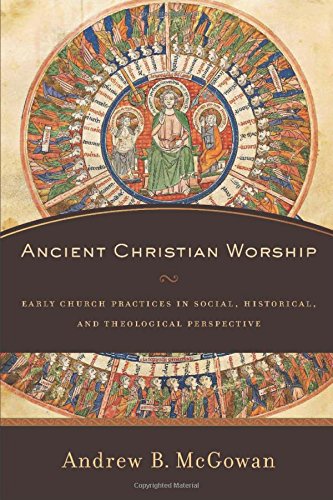
51NrR4p2cPLAndrew B. McGowan, Ancient Christian Worship: Early Church Practices in Social, Historical, and Theological Perspective. Grand Rapids: Baker Academic, 2014. Pp. 298 + xiv.

Andrew McGowan’s newest book is an exemplary guide to the ritual life of the earliest Christians. Indeed, insofar as the study of early Christianity tends to focus more on ideas than practices, this book is a particularly welcome contribution which might be profitably used in many a class on early church history.

McGowan begins with a helpful introduction which takes up the problems inherent in our understanding(s) of the term “worship.” In this book, “worship” refers not to an attitude of the heart or a particular set of music at the beginning of a church service, but rather “these practices that constitute Christian communal and ritual life, as reflected in the NT itself and thereafter” (7). As such, the book traces the development and significance of aspects of early Christian worship including obvious candidates such as the Eucharist and baptism as well as less obvious things like song and dance.

The book excels in presenting each aspect of ritual life in a clear and compelling manner. To take just one example, the chapter on “Meal: Banquet and Eucharist” does a very nice job of situating the Eucharist within the context of the Greco-Roman banquet, summarizing the key contributions of more scholarly works such as Dennis E. Smith’s From Symposium to Eucharist and Katherine M. D. Dunbabin’s The Roman Banquet. This ability to concisely pull together the main points of recent scholarship makes this book an ideal choice for introducing students to some of the key literature for each aspect of early Christian ritual. Returning to the focus of this chapter, McGowan deals with the well-known issues of reconciling the Last Supper traditions as found in the Markan and Pauline (1 Corinthians) texts, and traces the major lines of development between these early forms of the Eucharist (that is, within the context of a larger community meal) to its detached placement as a sacrament within a church service. Again, it is easy to imagine portions of the book to be used as required supplemental reading for any number of college or seminary courses.

All of this may of course be found in other treatments of the development of the Eucharist, but McGowan manages to surprise by looking at these subjects from new angles. Thus, for instance, he concludes the chapter on the Eucharist with a look at “kissing.” McGowan examines the “holy kiss,” the devotional kisses given to saints and martyrs, kisses in the context of baptism, and, finally, kissing at the Eucharist itself. By focusing on topics of this nature, McGowan helps us to see early Christian ritual as both more familiar and more strange than we originally anticipated.

In sum, at a time when some Christians are rediscovering the power of ritual (see, e.g., James K. A. Smith’s Desiring the Kingdom on the importance of habit-forming practices as central to the Christian pedagogical task), McGowan’s book is an excellent introduction to the complexity and wonder of the communal life of the first centuries of Christians. Highly recommended.

Disclosure: I received this book free from Baker Academic for review purposes. The opinions I have expressed are my own, and I was not required to write a positive review.

Posted in Uncategorized | 1 Comment

The Journey Continues at Radboud University

logo_radboud_universiteit

I’m very excited to publicly share the news that I’ll be completing my doctorate at Radboud University Nijmegen in the Netherlands, beginning this semester. The decision to transfer from UVa to Radboud was not made lightly, but I believe it to the best course for me, my family, and my research. One benefit: as an external researcher, I can live and work (a real job!) in the US as I finish my program; I’ll only have to go over to the Netherlands at the end for my defense.

1349255989993947_resize_300_225

Under the supervision of an NT scholar at Radboud, I’ll be writing a dissertation/book provisionally entitled The Testimony of the Spirit. Some elements of this project will appear this year in Vigiliae Christianae as “The Spirit Speaks: Pneumatological Innovation in the Scriptural Exegesis of Justin and Tertullian.”

Many thanks to everyone who has helped make this transfer possible. I’m excited for the next few years! More info on Radboud can be found here.

Posted in Uncategorized | Tagged , , | Leave a comment

LBD Apostolic Fathers

If you’re not familiar with Faithlife’s Lexham Bible Dictionary, part of the Logos Bible Software family of products, it’s a very nice resource for people who want to study the Bible more deeply, with more than 6,000 entries at present. I believe that even people without Logos can access it (with a free account registration) at bible.faithlife.com.

In any event, I’ve done a few articles for the LBD, and, if you’re so interested, two are now online: “Second Letter of Clement” and “Apology of Quadratus.” Never heard of them? All the more reason to go find out!

Posted in Uncategorized | Tagged , , , , | Leave a comment

“The Spirit Speaks”: SBL and Print Updates

If you’ll be visiting sunny San Diego (a huge improvement from blustery Baltimore, I expect) later this month for SBL, consider yourself invited to what I expect will be a very interesting session on “Spirit and Bible: The Development of Early Accounts of the Spirit in the Christian Scriptures.” I’m certainly looking forward to presenting alongside such a distinguished group of scholars. Here’s the details:

Screen Shot 2014-11-03 at 4.32.02 PM

Finally, I’m pleased to share the news that the full-length version of this project is scheduled to appear some time in 2015 in the journal Vigiliae Christianae. Here’s the abstract:

This paper considers the role of the Spirit within early Christian writers’ use of prosopological exegesis, an interpretive method which seeks to identify various persons (prosopa) as the “true” speakers or addressees of a Scriptural text in which they are otherwise not in view. While scholars are increasingly recognizing that, for some early Christian writers, the Spirit could himself be a speaking agent, there remains no systematic analysis of the texts in which the Spirit speaks from his own prosopon. After making just such an analysis, focusing on key texts in the writings of Tertullian and Justin Martyr, this paper concludes that the need for divine testimony concerning both the Father and the Son was the central motivating factor for assigning OT quotations to the prosopon of the Spirit. In particular, this paper argues that this emphasis on the Spirit’s role as one who testifies is a direct outgrowth of the portrayal of the Spirit in the Johannine corpus, and arose in the context of conflict with Judaism concerning the cessation of the Spirit. By making this connection, we have a new means by which to glimpse the theological dynamics at work in the pre-Nicene period that would contribute to the development of a distinctively Trinitarian, and not merely binitarian, view of God.


Posted in Uncategorized | Tagged , , | 2 Comments

Book Review: Basil of Caesarea

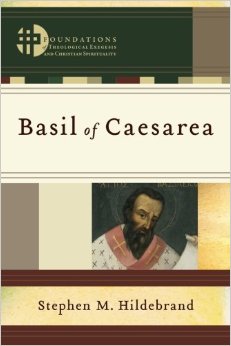
Stephen M. Hildebrand, Basil of Caesarea. Foundations of Theological Exegesis and Christian Spirituality. Grand Rapids: Baker Academic, 2014. Pp. 204 + xx.

UnknownIn this third volume in the Foundations of Theological Exegesis and Christian Spirituality series, Franciscan University’s Stephen M. Hildebrand takes up the study of the well-known Cappadocian Basil of Caesarea. Without question, Hildebrand provides, in one volume, a very thorough account of Basil’s life and thought. After a brief account of Basil’s life (chap. 1), Hildebrand gives introductions to Basil’s views on theological anthropology (chap. 2), revelation both general and specific (chap. 3), trinitarian theology (chaps. 4-5), Christian discipleship (chap. 6), monasticism (chap. 7), and tradition (chap. 8).

Hildebrand in each chapter provides nuanced engagement with relevant secondary literature, and yet the depth of his analysis, which often assumes great familiarity with the world of fourth-century Christianity, at times might place this book beyond the “educated lay readers” included in its target audience (xi). On the other hand, the book’s consistently laudatory tone towards Basil might turn off some readers in the academy. A timeline, giving the dates of Basil’s most important writings and significant events in his ecclesiastical career, would have been a welcome tool for the reader’s reference, especially when tracking Basil’s theological development over time.

Still, Hildebrand’s introduction to Basil of Caesarea will no doubt serve as a very helpful entrance into the world of Basilian scholarship. Not only that, but Hildebrand’s summary of Basil’s theological method as “weav[ing] together the dogmatic and the ascetic” (166) provides much food for thought for contemporary Christianity. While many Christians continue to exalt either the heart or the mind at the expense of the other, Basil stands as an example of one whose “theology and spirituality converge into a single movement of the person—or rather, the human community—toward God” (167). In presenting Basil in this light, Hildebrand does service not just to the academy but to the church as well.

Of particular interest to me was Hildebrand’s discussion of Basil’s understanding of the relationship between Scripture and tradition. The full divinity of the Holy Spirit was something that really did not receive much attention until Basil, whose On the Holy Spirit is devoted to that exact topic. While Basil argued for the Spirit’s full divinity, his many opponents utilized an argument which we will find familiar: that of sola scriptura. Basil’s opponents blast him for not providing Scriptural proof of the Spirit’s divinity. Basil, however, “argues that the Scriptures cannot be rightly understood apart from apostolic and patristic tradition, and in this case the tradition is liturgical” (93). To quote Hildebrand’s conclusions more fully (96):

Basil realized that his opponents had focused too narrowly on the authority of the Scriptures. Their demand for explicit scriptural proof for all teachings compromised the integrity of the faith. […] As did fathers before him, Basil learned that the Scriptures did not interpret themselves, and, as they did, he thinks that the rule of faith enshrined in the liturgy has a special place here. […] That is to say that authentic tradition must be consistent with apostolic (in the broad sense) liturgy and worship.

There are two things worth noting here. First, we owe the very doctrine of the full divinity of the Spirit to extra-biblical innovation (that is, to tradition, and not Scripture). Of course, tradition and Scripture are deeply interwoven, but in this case it is noteworthy that Basil’s opponents appealed to the principle of sola scriptura in order to deny the divinity of the Spirit. A rigid understanding of sola scriptura, both then and today, is not a recipe for orthodoxy. Second, Hildebrand correctly draws our attention to the role of worship in the formulation of tradition. It is likewise true both for Basil and for us that a church’s worship is the mother of a church’s theology. We should not underestimate the power of our “liturgy” (no matter how explicit or implicit that liturgy may be) in shaping our core understanding of the Christian faith. With this as just one example, I found Hildebrand’s book to be both historically informative as well as contemporarily relevant.

Disclosure: I received this book free from Baker Academic for review purposes. The opinions I have expressed are my own, and I was not required to write a positive review.

Posted in Book Review, Church Fathers | Tagged , , , , , | 5 Comments

Chrysostom’s Principles of Interpretation

chrysostom_oratorical_festivalI’m increasingly interested in how John Chrysostom utilized Scripture, both in his biblical commentaries and otherwise. Like most other early Christian figures, Chrysostom does not spend much time explicitly setting forth his method of interpretation (notable exceptions include Origen’s On First Principles and Augustine’s On Christian Doctrine, among others), but in one of his homilies on Galatians 1, Chrysostom does divulge one of his most important principles for interpreting Scripture: attention to context.

It is not the right course to consider words alone, or to examine the language by itself, because this will cause many errors. Rather we must consider the intention of the writer. And unless we follow this methodology in our own discussions, and look into the mind of the speaker, we will make many enemies, and everything will be thrown into confusion. This is not only true in regard to words, but we have the same result if we do not follow this rule when considering the actions of people. For example, surgeons often cut and break certain bones, and so do robbers. But it would be sad if we were not able to distinguish one from the other. Again, consider murderers and martyrs. When they are tortured, they suffer the same pains, yet the difference between them is very great. Unless we observe this rule, we will not be able to discriminate in these kinds of matters. Instead, we will end up calling Elijah and Samuel and Phineas murderers, and Abraham a murderer of his son. This will be the result if we go around scrutinizing bare facts without taking into account the intention of the participants.

In other words, the ancient and modern practice of “proof-texting,” of ripping out verses from their context as evidence for some view or another, is rejected in favor of careful attention to the context of the word or action. Particularly interesting is Chrysostom’s interest in “the intention of the writer,” which in some respects anticipates the more modern concern with authorial intent.

This passage falls in the midst of Chrysostom’s exposition of Gal 1:16-17. Here Chrysostom is concerned that Paul’s declaration that he did not go to Jerusalem to consult with the apostles there might be a sign of arrogance.

This expression when considered by itself can easily prove a stumbling-block and offensive to many hearers. But when it is kept in its context, everyone will agree with it and admire the speaker. So we shall do that… Let us then look at Paul’s intentions when he writes this. Let us consider his outlook and general conduct towards the apostles so that we may arrive at his meaning here.

Neither here nor previously did Paul speak with the intention of disparaging the apostles or of praising himself. How could he have intended to praise himself when he included himself in his condemnation? Rather, his only intention was to guard the integrity of the Gospel. Those troubling the church had said that they were obeying the apostles, who allowed these observances, and not Paul who forbade them. In this way the Judaizing heresy had gradually crept in. Now he needed to resist them resolutely, in order to check the arrogance of those who had improperly praised themselves, not, however, in order to speak against the apostles.

That is why he says, “I did not consult with any man.” It would have been extremely absurd for one who had been taught by God, afterwards to consult men. It is proper that someone who learns from men should in turn take advice from men. But why should someone who has been granted that divine and blessed voice, and who had been fully instructed by God, who possesses all the treasures of wisdom, later ask advice from men? It would be more fitting for him to teach others, not be taught by them. So Paul was not speaking arrogantly, but only showing the distinctiveness of his own commission. “Nor did I go up to Jerusalem,” he says, “to see those who were apostles before I was.” Because his opponents were continually repeating that the apostles were before him, and were called before him, he says, “I did not go visit them.” If he had needed to communicate with them, God, who revealed to him his commission, would have given him a command to do so.

Here, though, we encounter a problem which reveals a further point of Chrysostom’s method of interpretation: that Scripture interprets Scripture. As is well known, Paul’s declaration in Gal 1:17 that he did not go to Jerusalem to consult with the apostles immediately after his conversion appears to contradict the account in Acts 9:26, in which Paul immediately goes from Damascus to Jerusalem and meets with the apostles. Chrysostom anticipates this objection and resolves the problem in the following way:

Is it true, however, that he did not go to Jerusalem at all? No, he did go there, in fact, he went in order to learn something from them. But under what circumstance? A question arose on this subject in the city of Antioch, the church which had from the beginning shown so much zeal. They discussed whether or not the Gentile believers ought to be circumcised. In response, Paul went to Jerusalem along with Silas. So how can he say that he did not go up or confer with them? First, because he did not go up of his own accord, but was sent by others. Second, because he did not go to learn, but to change the opinions of others. From the very beginning his position was that which the apostles later confirmed, that circumcision was unnecessary. But when these people did not accept his position, and appealed to those at Jerusalem for support, Paul went up not to be instructed or corrected, but to convince the opposition that those at Jerusalem agreed with him. From the very first he understood from the proper mode of conduct, and needed no teacher. From the first, before any discussion took place, Paul maintained without wavering what the apostles, after much discussion later confirmed.

Luke shows Paul’s purpose in this journey in his account, where he relates that Paul argued at great length with them on this subject before he went to Jerusalem. But when the brothers chose to be informed on this matter by those at Jerusalem, Paul went up for their sake, not on his own. His expression, “nor did I go up,” means that he neither went at the beginning of his teaching ministry, nor in order to be instructed. Both are implied by the phrase, “I did not consult any man.” He does not merely say, “I did not consult,” but adds, “immediately.” And his later visit was not made to gain any additional instruction.

Now, we may find Chrysostom’s attempt to harmonize these texts more or less persuasive, but what is clear is his belief that all Scripture, inspired by the same Spirit, should be interpreted in such a way that it does not contradict other Scripture.

—Thanks to the Sacra Pagina blog for pointing me to this interesting text. Translation from Fourth Century Christianity.

Posted in Patristic Exegesis | Tagged , , , , | 1 Comment

Augustine on Literal and Figurative Interpretation (2)

Saint_Augustine_PortraitAs we saw previously, Augustine’s general rule of interpretation centers on the notion of charity: if the literal level seems to lead away from the love of God and love of neighbor, an allegorical meaning must be sought. In practice, however, this is something of a difficult matter.

To take just one problem: what should we do with passages in the OT that appear to commend certain behaviors that, in light of further revelation, may now be considered immoral (for instance, the patriarchs’ polygamy). In light of what Augustine has said thus far, we might be tempted to take the patriarchs’ polygamy figuratively, but Augustine, out of a desire to preserve the essential narrative of salvation history, understands this literally, but to be only acceptable in the patriarchs’ day “because of the times” (3.18.26). Augustine at this point seems more interested in giving a lengthy digression related to his view on sexual continence in marriage (thankfully, the patriarchs did not suffer “that domination of the libido” even having multiple wives; cf. 3.20.29), but he does offer the following general statement on how salvation history shapes interpretation (3.22.32):

Therefore, although all or almost all deeds which are contained in the Old Testament are to be taken figuratively as well as literally, nevertheless the reader may take as literal those performed by people who are praised, even though they would be abhorrent to the custom of the good who follow the divine precepts after the advent of the Lord. He should refer the figure to the understanding, but should not transfer the deed itself to his own mores. Many things were done in the course of duty in those times which now cannot be done without libidinousness.

In other words, some things that were allowed prior to the advent of Christ are subsequently condemned. Nevertheless, if these actions or behaviors were not condemned under that dispensation, they should be taken literally, but are not to be applied among believers today.

To take just one more problem: what limits are there, in Augustine’s mind, on figural interpretation? On the one hand, Augustine seeks to interpret Scripture with Scripture, such that “in those places where things are used openly we may learn how to interpret them when they appear in obscure places” (3.26.37; cf. 3.28.39); nevertheless, the same image or metaphor is not necessarily used consistently across the Scriptures, and thus careful attention to context is necessary. For Augustine, though, pinning down a single textual referent is not of great importance, so long as the interpretation contributes to charity (3.27.38):

When, however, from a single passage in the Scripture not one but two or more meanings are elicited, even if what he who wrote the passage intended remains hidden, there is no danger if any of the meanings may be seen to be congruous with the truth taught in the passages of the Holy Scriptures.

Authorial intent, then, is subordinated to the notion of the Spirit standing behind all Scripture, who uses these human words to lead the reader into that truth which leads to love of God and love of neighbor.

Augustine concludes his discussion of his method of biblical interpretation with a summary and an exposition of the Rules of Tyconius, a Donatist who put forth seven rules which would unlock the meaning of the Old Testament. These Rules are conveniently summarized at the Sacra Pagina blog (here).

Posted in Patristic Exegesis | Tagged , , , , | Leave a comment

Augustine on Literal and Figurative Interpretation (1)

Saint_Augustine_PortraitIn light of my previous post (here), one very reasonable question might have come to mind: how did the Fathers determine what in Scripture was to be taken literally, versus what is to be understood figuratively? This is hardly an abstract debate: Origen’s decision to castrate himself (to “become a eunuch for the sake of the kingdom”) serves as a classic example in which it’s probably safe to say that he made the wrong choice (something which he himself concluded later in his life).

While different early Christian writers used different criteria in deciding what was to be understood literally as opposed to figuratively, Augustine’s stands out as particularly memorable, even poignant. In his words (On Christian Doctrine, 3.10.14; trans. Robertson):

And generally this method [for distinguishing literal from figurative] consists in this: that whatever appears in the divine Word that does not literally pertain to virtuous behavior or to the truth of faith you must take to be figurative. Virtuous behavior pertains to the love of God and of one’s neighbor; the truth of faith pertains to a knowledge of God and of one’s neighbor. For the hope of everyone lies in his own conscience in so far as he knows himself to be becoming more proficient in the love of God and of his neighbor.

What, though, is virtuous behavior? Augustine recognizes the existence of ethical relativism from culture to culture, and thus shifts the emphasis back to Scripture, which, in his mind, “teaches nothing but charity” (3.10.15); by “charity” he means nothing less than the soul’s increase in its twofold love toward God and neighbor, both for God’s sake (3.10.16, here drawing on arguments from Book I). Thus, in summary (3.15.23):

In the consideration of figurative expressions a rule such as this will serve, that what is read should be subjected to diligent scrutiny until an interpretation contributing to the reign of charity is produced. If this result appears literally in the text, the expression being considered is not figurative.

Augustine then turns to some examples (3.16.24):

If a locution is admonitory, condemning either vice or crime or commending either utility or beneficence, it is not figurative. But if it seems to commend either vice or crime or to condemn either utility or beneficence, it is figurative. “Except you eat,” He says, “the flesh of the Son of man, and drink his blood, you shall not have life in you” (John 12.25). He seems to commend a crime or a vice. It is therefore a figure, admonishing communion in the Passion of Our Lord, and sweetly and usefully concealing a memorial of the fact that His flesh was crucified and wounded for us.

The Scripture says, “If thy enemy be hungry, give him to eat; if he thirst, give him to drink” (Rom 12.20). This undoubtedly commands a beneficence, but what follows might be taken to command a crime of malevolence: “For, doing this, though shalt heap coals of fire upon his head.” Therefore do not doubt that this is said figuratively. And since it can be interpreted in two ways, one admonishing harm, another admonishing benefit, charity should call you to beneficence so that you understand the coals of fire to be the burning sighs of penitence which heal the pride of the one who sorrows that he was an enemy of the man from whom he had received assistance for his misery.

This all seems straightforward enough, but, as Augustine himself admits, some matters are more complex, and we’ll turn to these next time.

Posted in Patristic Exegesis | Tagged , , , | Leave a comment