The New Academic Year

As “back to school” week hits for me and countless others, it’s worth stepping back and reminding ourselves why we’re engaged in the academic pursuit and what it could mean for our lives and our faith. The following two posts have some really great insights that I recommend to everyone headed back to campus this fall:

First, Duke’s Stanley Hauerwas has written “an open letter to young Christians on their way to college” here. As you’d expect, Hauerwas has some profound insights even for those on their way into PhD programs! Plus, he starts his “letter” by quoting UVA’s own Robert Louis Wilken, so how could it not be a great read?

Second, the InterVarsity Emerging Scholars Blog’s David Williams has written a three-part series on “Why You Must Be Dying to be a Christian Scholar,” which concludes here. A title like that speaks for itself, but I’d especially recommend this piece to those who are starting or going back to seminary this fall. Be sure to read the first two parts, accessible through the link above.

Happy new academic year!

Posted in Uncategorized | Tagged , , , | 1 Comment

Were the Fathers Inerrantists? A Response to Kevin DeYoung

Kevin DeYoung has co-authored some good popular-level books challenging the “emerging church” movement and calling my younger generation of Christians to participate in the local church. This is all well and good. But he’s got a post up today on the Gospel Coalition Blog (here) that claims to identify “the Christian view of Scripture” with modern-day inerrancy.

There are several issues worth responding to in this piece, but perhaps the most important one is that DeYoung has seriously misrepresented the patristic tradition regarding the nature of Scripture. According to DeYoung, “This high view of Scripture as the inerrant divinely-spirated word of God has been the position of Christians from the beginning,” and he cites Clement of Rome, Irenaeus, Origen, Augustine, and Jerome to this effect. Now, there is no doubt that the Fathers believed the Scriptures to be divinely inspired and therefore could, in a sense, speak of them as “without error.”

But the problem for DeYoung is that what the Fathers mean as “without error” is very, very different from what I suppose he means by inerrancy. According to the Chicago Statement on Biblical Inerrancy, “the text of Scripture is to be interpreted by grammatico-historical exegesis.” Simply put, this means that, genre allowing, we are to interpret Scripture according to its literal sense. For DeYoung and modern-day inerrantists, it is this literal sense of the Bible that is inerrant. But the Fathers had an entirely different view. As patristics scholar D. H. Williams summarizes, “As a generalization about the patristic mind, it is fair to say that the fathers affirmed an infallible Bible, although it was not an infallibility of the text so much as much as it was an infallibility of the divine intention behind the text” (Evangelicals and Tradition, 91). Similarly, Frederick Norris observes that “The Fathers’ sense of the trustworthy character of Scripture can hae them speak about its lack of errors, but they never protect the Bible with the doctrine of inerrancy that was developed in seventeenth-century Protestantism” (quoted in ibid.).

The early fathers observed, like we do, certain historical inconsistencies, conflicting accounts, and even possible contradictions in the biblical text, and tried to harmonize them in light of their view of the Bible as divinely inspired. The quotations DeYoung cites exemplify this mentality. But here’s the rub: one of the primary ways that the Fathers harmonized problem passages was to deny the literal sense of the text. That is to say, the “ inerrant truth” of a passage was often found not in its literal sense, but in its moral or allegorical one. Or, to put it yet another way, the Fathers “claimed that points of obscurity or even contradiction within the Bible provided an oppportunity for the Spirit to work in a Christian heart because the dilemma was more than the human heart could comprehend” (Evangelicals and Tradition, 104).

Examples of this in the patristic literature are abundant. Wherever the Fathers found problems with the biblical text, their way of preserving their version of “inerrancy” was to deny the literal sense of the text (in a sense, admitting the problem is real) and find the “true meaning” in an allegorical interpretation. In their excellent book Sanctified Vision: An Introduction to Early Christian Interpretation of the Bible, John J. O’Keefe and R. R. Reno give many examples of this phenomenon. For instance, in the first of the Genesis creation accounts, God creates light on the first day, but creates the sun, moon, and stars on the fourth day. Origen and Augustine, among other Fathers, declared this to be literally impossible. Their solution, though, their way of rescuing the “inerrancy” of Scripture, was to admit the literal sense was unworkable and instead propose an allegorical one. For Augustine, this meant that the light of the first day represented spiritual truth, while the light of the fourth day represented real physical light. Yes, the very order and words of Scripture matter (they matter a great deal!), but they contain real problems that are dealt with in a way that I cannot imagine that DeYoung would approve of.

DeYoung’s presentation of the patristic view of the Bible is, therefore, deeply misleading. There is much more that could be said; Jesus’ statement in John 10.35 fails to prove what DeYoung thinks it does (Jesus believed in inerrancy). Nor does DeYoung give us any guidance on what to do with text critical problems in which it is clear that even the biblical writers themselves were aware of problems with what other biblical authors had written (e.g., the earliest and best MSS of Mk 5.1 read “Gergesenes” or “Gerasenes,” but this places us some 37 miles from the Sea of Galilee; Matthew (8.28) corrects Mark’s geography by moving the story to the region of the “Gadarenes,” where it would make far more sense. Cf. also the problem of “Abiathar” in Mk 2.26, which has been “corrected” in Matt 12.4 and Luke 6.4). And so on.

DeYoung wants us to believe that “when we reject inerrancy we put ourselves in judgment over God’s word.” This may be true, but in his view are we not putting a man-made construct (inerrancy, which, despite DeYoung’s protestations, was most certainly not around in its existing form in the patristic period) above God’s word? Would it not be far better, and a more secure resting place for our faith, to ground our belief ultimately in Jesus Christ, and not in our own understanding of what we want and pretend the Bible to be? See further here.

Posted in Evangelicalism | Tagged , , , | 7 Comments

In Laymen’s Terms: Testimonia

21n3X98SbzLContinuing to dig into the literature on early Christian use of the Jewish scriptures, I’m now working through Martin C. Albl, “And Scripture Cannot Be Broken”: The Form and Function of the Early Christian Testimonia Collections (NovTSup 46; Leiden: Brill, 1999). Albl’s book, a revised version of his dissertation at Marquette University, has come highly recommended from several people, and so far it’s certainly living up to expectations.

Albl is chiefly concerned with the so-called “testimonia hypothesis,” which he defines as “the proposition that the earliest Christians collected, edited, and gave authoritative interpretations to a select group of scriptural quotations which served as proof-texts for basic Christian beliefs” (xv). The basic evidence for this phenomenon is found in the fact that certain passages (e.g., Ps 22 and 110) were far more important in early Christianity than other OT texts (e.g., Song of Solomon). Moreover, the fact that these same passages are consistently incorrectly attributed, mixed or linked with other quotations, or deviate from known scriptural texts (MT or LXX) suggests that we’re dealing with some kind of earlier scriptural extract collection from which these later sources are drawing. But how did this process work?

The first major study of testimonia was that of Edwin Hatch, who argued that early Christians took over the Jewish practice of making written collections of OT quotations for various purposes. J. Rendel Harris took this a step further by hypothesizing the existence of a single Testimony Book of OT passages organized under the categories of “against the Jews” and “concerning the Christ.” C. H. Dodd took this overly simplistic view to task, and instead emphasized the oral process at work in collecting these related texts. Writers such as L. W. Barnard and R. A. Kraft have argued for an evolutionary process in which oral traditions gradually led to the creation of larger written collections.

Albl comes down on the side of written testimonia collections. Perhaps his strongest piece of evidence is the existence of both Greco-Roman and Jewish extract collections from the period around that of early Christianity. At Qumran, for instance, scholars have discovered a document called 4QTestimonia, which simply consists of a series of quotations from the OT linked by catch-word connections, without any intervening comment. 4QTestimonia and other documents like it are proof that written extract collections existed in this day. The consistency of some of the phenomena described above (e.g., use of the same series of texts in independent authors) demonstrates a precision that we would more expect to find in written rather than oral transmission.

Posted in Testimonia | Tagged , , , , , , | 2 Comments

The Enduring Value of Tradition

A couple of excellent, thought-provoking quotes from D. H. Williams (see previous post) on the enduring role and value of tradition that I can’t help but share:

“Unlike the trivial sort of gospel preaching that one encounters in too many churches today where the goal of ‘accepting’ Christ is so that one will go to heaven, the early fathers believed that God’s salvation through the life, death, and resurrection of Christ meant providing a believer with the means to perceive God and thereby share in his divine life. That is, salvation was supposed to culminate in the divine theosis or deification – becoming transformed according to God – a seminal part of the teaching of early fathers…the point is that faith is a divine work of salvation ‘in us’ as well as ‘for us’ in order to change us, that we may behold God” (Evangelicals and Tradition, 140).

I can’t help but wonder how much of the malaise and decline of American evangelicalism stems from precisely this “dumbing down” of the Gospel, giving congregants and a needy world alike just one little nugget of gold when there is in fact an entire storehouse full of the treasures of the wonder of God’s salvation. One of my Dallas professors was infamous for an approach to evangelism that boiled down to a “presentation of the gospel” (exactly what Williams criticizes) which could be “accepted” by signing a little card to that effect. Is it really God’s intention, I can’t help but wonder, that we make a one-time “acceptance” of him for the sake of a “get out of hell free card,” when in fact what his desire (as the church fathers demonstrated) is to invite us ever deeper into the mystery, love, and fellowship of the Triune God?

I suspect a great deal of the approach to Christianity that Williams criticizes stems from our modern American predispositions (1) to drive a hard distinction between “spiritual, simple faith” and “dry, intellectual theology”; (2) to privilege individual dimensions of salvation to the complete neglect of the corporate or cosmic elements; and (3) the belief that people are basically stupid and “can’t be bothered” or trusted with anything beyond the most simple spiritual truths.

“Preaching easily slips into the mode of moralizing or anecdotal storytelling, and eventually the flock of God can no longer stomach a diet that might cause them to think deeply about the content of the Christian faith. Congregations are well schooled in neatly dividing the faith into practical and theoretical aspects, convinced that only the former are of concern to them. Theology is therefore an elective of the Christian life, not necessary and too divisive for a religion of civility. In their quest to reach culture, evangelical congregations have become the cultural preferences of their audiences: anti-institutional, informal, non dogmatic, therapeutic, and unaware of the difference between tolerance and moral confusion.

Yet many evangelicals are discovering that no amount of creative packaging and marketing of the gospel will rescue church ministry if they lose the theological center that enables them to define the faith and prescribe the kinds of intellectual and practical relations it should have in the world” (178-9).

Ouch. It’s hard to argue with his assessment. But as I think about my own preaching and teaching, I want to assume the best of people; I believe that most laypeople are in fact hungry to go deeper in their walk with God and learn more about the faith. I suspect that some congregants’ suspicions stem more from bad past experiences or fear of the unknown (the “hunker down because what’s out there might destroy my faith” mentality) than anything else, and that most of them are in fact ready for a more high-calorie diet, provided it’s fed in a slow and gentle manner. Still, sometimes it’s not all about giving the people what they want; it’s often also about giving the people what they need

Posted in Evangelicalism | Tagged , , , | Leave a comment

Defining Tradition

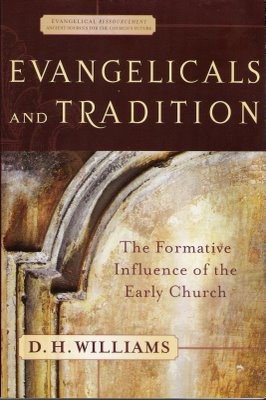
williams_evangelicals-and-traditionThanks to a long road trip, I’ve had time to read through another book of particular interest. D. H. Williams, professor at Baylor University, has written a helpful introduction to “the formative influence of the early church” and its implications for today in his Evangelicals and Tradition (Baker Academic, 2005).

Williams’ interest is in “the tradition, the foundational legacy of apostolic and patristic faith, most accurately enshrined in Scripture and secondarily in the great confessions and creeds of the early church” (24). It is this latter sense of tradition, so often neglected in evangelical circles, that Williams seeks to return to its proper place. As Williams notes, Paul exhorted his readers to “stand firm and hold on to the traditions we passed on to you” (2 Thess 2.15), with “traditions” having the sense of “a dynamic of handing over and receiving a living and active transmission of the church’s teaching” (33). As this passage and 1 Cor 11 and 15 make clear, “there is no tension between the gospel as revelation and the gospel as tradition,” for they are “but two sides of one coin” (ibid.).

What, though, are the “limits” of tradition, so to speak? Clearly not all tradition is good tradition. Williams argues for the normativity of the church’s apostolic and patristic tradition in the form of the doctrine, liturgy, prayer, and exegesis which has formed the basis for all future Christian thought and worship. Though Scripture “possesses a normativity that is superior to the tradition,” it is nevertheless the case that “the church of Christ has always depended on the way in which the former has been mediated through the latter” (51). Williams defends this claim (against the “Bible only” crowd) with the following points, as I have summarized it below:

1. Our modern division between “apostolic” and “patristic” periods is, like all such divisions, an artificial construct. While writings which would come to be included in the NT were written well into the first century (e.g., Revelation in the 90s) if not later (2 Peter in the early second century), so-called “patristic” writings were written in the 90s (1 Clement; Barnabas) and perhaps as early as the 50s or 60s (the Didache). There is far more continuity between the two than evangelicals care to realize.

2. The NT itself is a testimony to the patristic legacy, for “the scope and extent of the Bible were realized by the patristic church, which discerned what was Scripture according to the criteria of apostolicity, inspiration, and so on” (53). It is worth remembering that the first Christian “canon” (a fixed norm or rule for determining the parameters of Christian thought and life) was not a list of authoritative books but the church’s basic profession of faith. “What the church believed was canonical long before that belief took written, codified forms,” with the result that “the earliest canons or norms of the preaching and defending of the early tradition served as the standard for the canonization of texts” (55). In other words: the church’s basic interpretation of the meaning of Jesus’ life, death, and resurrection (the so-called “Rule of Faith”) developed prior to the canonization of the NT, and it was in fact this Rule of Faith which came to determine why the Gospel of Mark, for instance, was included in the NT and the Gospel of Thomas was not. While Scripture has a unique authority as the Word of God, it is nevertheless clear that “the scriptural canon came about in its shape and content as an embodiment of the canonical tradition, and the tradition could only be legitimated by standing in unity with the teaching of Scripture” (56). This circular process necessitates, again, that Scripture and tradition be seen as two sides of the same coin.

3. Stemming from this previous point, tradition provides the “interpretive key” for reading Scripture in an orthodox sense. The early baptismal formulas and creeds, which were believed to represent the “true essence” of Scripture, gave language to ideas such as the Trinity or the hypostatic union that are characteristic of Christianity but nevertheless not explicitly taught in Scripture. Again, the problem was (and is) that anyone could read Scripture in a way that could support just about any theological premise. Mastering the church’s basic confessions was a way to ensure that the Scriptures were read in accordance with the apostolic rule of faith. Here it is important to note that even the magisterial Reformers (Luther and Calvin), who held to sola scriptura, believed in the importance of the creeds as means of protecting the church from error; Scripture could never be understood apart from the foundational tradition of the church. In other words, “The principle of sola scriptura was not intended to be nuda scriptura!” (97). Alas, American hyper-individualism and resistance to authority have created a “just me and the Bible” attitude that is totally without precedent and parallel in church history (except for, well, heretics).

In summary, we would do well to mind Williams’ point that “in the end, believers do not believe and, more importantly, keep believing in isolation. The Bible is capable of being understood only in the midst of a disciplined community of believers whose practices embody the biblical story. As part of this embodiment, we are in need of ‘spiritual masters,’ namely, the venerable voices of the historical church whose journeys empower and enlighten our own pilgrimage toward what is authentically Christian” (101). In a day and age when “authentic” is defined as what is “contemporary” and “relevant,” it is long past due to recover the sense of “authentic” as that which has stood the test of time, and been embraced everywhere, always, and by all.

Posted in Evangelicalism | Tagged , , , , | 1 Comment

The Rise of Scripture

biblical-scroll_0After seeing this book footnoted elsewhere for the umpteenth time, I picked up Kugel & Greer’s Early Biblical Interpretation and have found it exceedingly worthwhile. Writing the first half of the book, which focuses on early Jewish readings of the Hebrew Bible (that is, from the postexilic through rabbinic periods), James L. Kugel summarizes the various currents that shaped early biblical interpretation and some of the resulting forms of exegesis. Just to pick one interesting idea to share, Kugel has the following to say concerning the “rise of Scripture” (p. 17-19).

First, Kugel cites Jeremiah 1.9, in which Yahweh places his hand, and thus his words, on Jeremiah’s mouth, and Jeremiah 15.16: “Your words were found and I ate them, and your words became to me a joy and the delight of my heart.” Writing c. 600 BC, the prophet’s emphasis is on God’s spoken word, which he has “found” (?) and then “eaten,” thus nourishing him for his ministry. Note we have no reference here to any “written” words of God.

Second, Kugel notes how the prophet Ezekiel (writing perhaps a generation later?) echoes and transforms the language found in Jeremiah: “And when I looked, behold, a hand was stretched out to me, and behold, a scroll of a book was in it…and it had writing on the front and on the back” (Ezek 2.9-10); this scroll is given to Ezekiel to eat, who then does so (Ezek 3.1-3). Thus, writes Kugel, “in Ezekiel, God’s speech has already become a text; and the very act of eating God’s word now demands impossible ‘obedience’ and self-control, swallowing up an actual scroll.”

Kugel argues that this shift parallels the fact that “during the exile, and all the more so afterward, the divine word was increasingly a text and became the more hallowed the more the parchment yellowed and turned brown and cracked.” Further underscoring this point, he finally cites the prophet Zechariah, who wrote after the return from exile (c. 520). Perhaps echoing Ezekiel, Zechariah writes that he saw “a flying scroll” which “is the curse that goes out over the face of the whole land…I will send it forth, says the Lord of hosts, and it shall enter the house of the thief, and the house of him who swears falsely by my name; and it shall abide in his house and consume it, both timber and stones” (Zech 5.1-4). Unlike in Ezekiel, Zechariah does not eat the scroll, nor does he even touch it; instead, it only passes by. The role of the prophet has diminished; “For here is Scripture as Actor, the written word which flies like an angel to carry out God’s decrees and indeed, like the ‘angel of the Lord’ in the Pentateuch, is even able to wreak physical destruction on those who have incurred the divine wrath.”

In these closely related texts, therefore, there is an increasing significance and power ascribed to the written word of Scripture, likely coming at the expense of the independent authority of the Hebrew prophet. From a Christian perspective, though, I wonder how much farther we could extend this trajectory: for in Jesus, the early Christians believed, the written word had been fulfilled and, perhaps, even incarnated as the God-Man, the Word and Wisdom of God (cf. Ignatius, Phil. 8.2).

Posted in Hebrew Bible | Tagged , , , , , , | 1 Comment

The Birth of Christian Asceticism

What possessed early Christians to withdraw from society, living simple lives either alone or in isolated communities? My answer to this question has previously been an merely sociological terms, but it turns out there might be a biblical explanation as well.

Having just read Wayne A. Meeks’ The Moral World of the First Christians (Fortress, 1986), I was struck by his account of how early Christian asceticism developed (p. 105-8). Meeks begins by noting that many of Jesus’ sayings “seem to demand an ascetic detachment” from the world and all of its basic social structures. And it’s not hard to think of several examples of this, e.g., the sending of the twelve in Mk 6.8-11 (“take nothing for the journey except a staff…”). In the canonical gospels, the context for this ascetic lifestyle is relatively clear: it “does not appear to be a model for life in the kingdom. It is, rather, in an odd way, functional for the apostles’ extraordinary mission.” In other words, the eschatological urgency of the first apostles’ message necessitates this kind of lifestyle.

In the early church period (and even into contemporary times with certain missions strategies), the role of itinerant (“mendicant”) preachers has endured. But, then as now, this kind of itinerant ministry is dependent on the hospitality and charity of strangers. As such, the canonical Gospels seem to suggest that their audiences “are not asked to imitate the itinerants, but only to listen to them and support them–and the latter requires that they not abandon the world.” That is to say, if all Christians led the ascetic lifestyle that Jesus describes in Mk 6.8-11 and elsewhere, the mission would ultimately be self-defeating. The point of these verses, then, was to help early Christians (and Christians today?) discern between true mendicant preachers and false prophets, a theme that is picked up and developed through later first-century Christian literature (e.g., 2-3 John; Didache 11.22). The specialized role of the mendicant preacher would have made a great deal of sense in the ancient world, with both Jewish (the prophets) and Greco-Roman (the Cynics) parallels.

Still, it’s easy to see how this “specialized role” could give way to a de-contextualized understanding of these verses that would instead call all Christians to a radically ascetic lifestyle. Particularly under the influence of Cynic and Gnostic ideas, some Christians in the tradition of the Gospel of Thomas believed asceticism to be not “for the sake of an extraordinary mission, but because the world itself corrupts and kills.” As noted above, however, the NT primarily emphasizes staying within one’s social roles and structures, in part to be better able to support those who are in fact called to the mendicant, ascetic lifestyle. But for those in the Cynic-Gnostic tradition, “an eschatological ethos, adopted by prophets who called on people to confront an imminent transformation of life by God, becomes a way of life to be internalized.”

I think all this is quite interesting simply as an example of an early de-contextualized reading of Jesus’ Gospel ethics, but it’s also relevant for today: we can’t simply read every statement or command of Jesus (or Paul) as speaking directly to us. This may complicate our reading of Scripture, but it is nevertheless the right thing to do. Moreover, this does reinforce the point that not all modern Christians are called to “give up everything.” But some are, and it is the duty of the rest of us to provide for them, partnering with them with prayer, finances, and perhaps even housing. And we are called to be discerning, to (as far as we are able) make sure that those ministers of the gospel are truly called by Christ, and not by Mammon.

Posted in Early Christianity | 2 Comments

NovT 55.3 Published (L/PA Article)

I’m pleased to finally share the news that my article on the pericope adulterae has been published – my first venture into the realm of scholarly writing (and now, undoubtedly, first venture into the world of scathing reviews and dismissive footnotes). Brill kindly allows authors to post the post-print pdf of their articles on their personal websites, and so I’ve posted the electronic copy (just as it appears in print) under the “academic archives” tab.

For the complete table of contents for NovT 55.3, see here. Most university and seminary libraries provide free access, physically and/or electronically, to NovT and other major biblical studies journals.

UPDATE: I’ve written a guest post summarizing my article on Dan Wallace’s blog here.

Posted in Uncategorized | Tagged , , | 1 Comment

Simon Peter (3): Case Studies

Bockmuehl’s Simon Peter in Scripture and Memory concludes with two brief case studies that, he claims, demonstrate how the Petrine memory can illuminate our understanding of this central figure of the early church.

220px-Pope-peter_pprubensFirst, Bockmuehl looks at an exegetical issue. While Paul has a dramatic conversion story (regardless of how exactly said conversion is to be understood), the NT, at least on the surface, fails to give us one for Peter. Bockmuehl (155-157) focuses on Luke 22.31-32, in which Jesus tells Peter that Satan will sift him, but that when he has turned back (ἐπιστρέψας), he will strengthen the brothers. Ἐπιστέψω is a verb that is often used to denote moral or spiritual conversion (Lk 1.16-17; 2 Chron 24.19 LXX). Interestingly, despite the fact that by Luke 22 Peter has “left everything” (Lk 5.11), is given a promise to judge the twelve tribes (22.28-30), and has some amount of faith, Jesus clearly implies that his turning/conversion/repentance is still future. Luke does not give us a clear account of Peter’s “conversion” in the rest of his Gospel, but by the time Acts opens, Peter is clearly a different man, boldly proclaiming Christ and strengthening the others through his witness (fulfilling Lk 22.31-32). So when does the change happen? This is where Bockmuehl brings in reception: having demonstrated from other examples that Luke often “implicitly invites his readers to draw certain conclusions,” then “one of our best available exegetical guides is to ask what those earliest readers themselves concluded” (158). Looking at the Good Friday Rooster in early Christian art, the Acts of Peter, and 1 Pet 1 and John 21, Bockmuehl concludes that the it is the “crucifixion-resurrection sequence,” in which Jesus gazes disappointedly at Peter, who has disowned him (Lk 22.61), and in which Peter beholds the risen Lord (Lk 24.34) that brings about Peter’s repentance/conversion/turning.

Second, Bockmuehl examines an archaeological issue. How plausible is it that Simon Peter, the fisherman from Galilee, would lead a global mission culminating in his martyrdom in Rome? Bockmuehl notes that John 1.44 tells us that Peter and his brother Andrew came from the village of Bethsaida (presumably, the family later moved to Capernaum, where the Synoptics locate Peter’s mother-in-law’s house). The NT makes very little of Bethsaida, portraying it as highly resistant to Jesus’ ministry (Lk 10.13), but archaeology can help us fill in some of the gaps: Tell Bethsaida, 2.5 km north of the Sea of Galilee and just east of the Jordan, has been the site of annual excavations since 1988. The fascinating thing is that this site has no synagogue, no baptismal pools, no Jewish inscriptions, and a great deal of pig and non-kosher fish bones as well as some degree of Hellenistic fineware. From all of this, Bockmuehl concludes that “Bethsaida’s culture in the first century was under strongly Hellenistic influence” (174), so that “Peter almost certainly grew up fully bilingual in a Jewish minority setting […] the political context of Bethsaida would have afforded the young Peter a strong awareness of larger imperial realities” (175). Thus, “the young Peter’s Judaism in marginal circumstances would have left him precariously balanced between two very different, if equally religious, construals of his identity and vocation–nationalist zeal, on the one hand, and a global and multicultural articulation of faithful Jewishness, on the other” (176). Peter, it seems, was far better equipped, both culturally and linguistically, than James or any of the other Judaean-born leaders of the early church to take the gospel to the Jews of the diaspora.

Moving effortlessly from standard historical-critical fare to exegesis of non-canonical gospels, patristic texts, and archaeological data, all while seeking to find patterns and integrate elements across various strata of evidence, Bockmuehl’s careful historical work is certainly worth reading and emulating. I still wish the publisher would have included maps and images where appropriate, but on the whole Bockmuehl’s Simon Peter never fails to intrigue and illuminate.

Posted in New Testament | Tagged , , , , | Leave a comment

Simon Peter (2): From East to West

peter-the-keysIn the bulk of his Simon Peter in Scripture and Memory, Markus Bockmuehl provides a condensed, summary-style “encyclopedia of reception” of traditions concerning the apostle Peter, first focusing on those in the East (Gal; Matt; John; 2 Pet; Ignatius; Justin Martyr; various Syrian non-canonical texts) and then those in the West (1 Cor; Rom; Mark; Luke-Acts; 1 Pet; Clement of Rome; Marcion, etc.). Taking each of these texts in turn, he analyzes it for the extent to which it reveals something about Petrine living memory (see previous post).

Throughout, Bockmuehl’s work on reception relies on the strategy of analyzing a text’s implied reader; that is, when a text presumes familiarity with an individual or makes a claim that it feels no need to defend (that is, it would have been uncontroversial to the text’s audience), we can be reasonably confident that “the rhetorical appeal […] makes sense only if the author can assume a certain common knowledge of the events to be in place” (110), and that “shared memory allowed the readers to fill the gaps in the unspoken discourse” (111). Especially when claims could be easily proven one way or the other (through recourse to living witnesses or physical remains), this is a powerful tool for separating what was agreed upon as true from that which was novel or unprovable.

While Bockmuehl saves his conclusions for the next and final part of his book, the clear point of this section is that local memory of Peter is nearly absent from Palestine, Syria, Asia Minor, and Greece, but Rome is full of Petrine memory. This is explained, in part, by the likelihood that Peter left Jerusalem for Rome in AD 41 (cf. Acts 12:3) and by the destruction of the Jewish Christianity that would have preserved Petrine memory in Palestine following the Jewish wars of AD 70 and 135. Above all, Bockmuehl contends, Peter was remembered as the singular figure who had “the capacity to bridge the tensions between Paul’s radical mission and Jerusalem Christianity’s mission to Israel” (150).

Perhaps the most interesting things about these chapters, however, are the little nuggets that Bockmuehl drops in along the way on various matters. To wit:

On Ignatius: Despite the fact that Ignatius most frequently cites/alludes to Matthew (and particularly M, his special material), Ignatius often uses the traditions from M “against the thrust of its Matthean redaction,” such that Matthew may in fact be “close to the position of Ignatius’s opponents, whose praxis and self-understanding were more Jewish or Judaizing.” Though both coming from Antioch or thereabouts (and not more than a few decades apart), this huge shift in perspective vis-à-vis the Jews is attributed to a need to downplay the church’s Jewish origins in light of anti-Jewish tensions in the community at large (49, and see point below).

On the nature of John’s Gospel: “The Johannine narrative relates the events [of the Jesus tradition] in terms of their effective significance–reading the beginning from the end, and each part in light of the whole story, as this emerges in the memory of the living witness” (62). I think this is a spot-on description of the Fourth Gospel, acknowledging the Gospel’s complexity beyond simple categories of historicity and non-historicity.

On the nature of Matthew’s Gospel: Bockmuehl finds the consensus view placing this Gospel in the 80s in Antioch unconvincing, arguing 1) that “far from dwelling on the recent destruction of the temple, Matthew inserts into his Markan text a number of fresh redactional additions that presuppose the continued operation of the temple system,” and 2) assuming Markan priority, “the time required to transport Rome’s Petrine gospel [Mark] to the East and edit it for local use need not exceed a few months, and if, as has been plausibly argued, Matthew is a kind of ‘authorized edition’ of Mark, there would be incentive to produce it without undue delay” (68). “If Mark represents the Petrine gospel for Roman Christians, then Matthew arguably constitutes its enhanced revision for a Greek-speaking Syrian readership of believers in Jesus who saw themselves as Jewish. In other words, Matthew is designed to take the place of Mark in Syria and perhaps more generally” (70). I confess I love the freedom of the Brits to do things like date Matthew in the 60s and 2 Peter in the second century: guaranteed to make both liberals and conservatives mad!!

On Lukan-Johannine parallels: Bockmuehl highlights several important parallels between these two Gospels (Luke 5.3-10 // John 21.1-19; the sequence of events involving Peter during the passion and resurrection; the pairing of Peter and John during the passion narrative; etc.). Bockmuehl is open to either Luke’s knowledge of John or vice versa (120), and having encountered similar bizarre parallels between the two Gospels when working on my Judas paper, I wouldn’t be entirely surprised if there was something to this notion; perhaps both drew from common oral tradition in Judea/Palestine.

On Petrine Memory in Matthew: Having noted how “Matthew retains and in several cases significantly enhances precisely the sort of Palestinian ‘local color’ that might be expected to characterize the first generation or two of Petrine memory in Syria,” Bockmuehl concludes that, in fact, “Matthew may well take us closer to Peter and his world than Mark does” (88). In other words, even if Mark in some sense represents Peter’s “memoirs,” Matthew has included Palestinian-based traditions about Peter that Mark, in Rome, has not (e.g., Matt 16.17-19; 17.24-27; 19.28).

On Galatians: Bockmuehl provides something of a rereading of Galatians by suggesting that the “Gentiles” with whom Peter had stopped eating were not believers but unbaptized gentiles (based on arguments from lexical usage and Rabbinic law). Thus “Galatians makes consistently good sense when one reads every reference to both ‘gentiles’ and ‘the circumcision’ as denoting unbelievers.” Paul has no quarrel with Jews practicing the Jewish law, as has sometimes been suggested, nor does he think Jews should give up their food laws; instead, Paul “respects the Torah-observant mission to the Jews and asks only for recognition of the validity of law-free praxis in the gentile mission” (94).

On the surprising lack of Petrine memory in Palestine: “In the context of persecution and of the revolts against Rome, it is not difficult to see the attraction–in view of Roman and Jewish hostility–of a ‘protective anonymity’ for those who were personally acquainted with a Christian ringleader who either was or had been a fugitive and was possibly executed as a subversive criminal” (97). Bockmuehl draws on Richard Bauckham’s Jesus and the Eyewitnesses here and elsewhere.

On the surprising lack of information about Peter’s fate: Why do documents like Mark, Luke, 1 Clement, and, above all, Acts, not give us knowledge of the fates of Peter (and Paul) (especially if you assume Luke-Acts is written after their deaths, which almost all scholars do)? Attending to the issue of the implied reader, Bockmuehl postulates that “Peter and Paul are Luke’s greatest agents, yet the inference is that readers know something important about the climax of their fate in Rome [cf. Acts 1.8; 19.21; 23.11], which he does not wish to discuss in detail [cf. 1 Clem. 5-6]” because he and other early Christian writers are writing about events that “arguably continue to engender both searing memories and political peril for the Christian community” (113).

If I have one complaint about this section, it is that the discussions of archaeological and artistic evidence lack any accompanying photos or illustrations. Similarly, there are a few places where maps would be more effective than simple text. Whether the decision not to include these things lies with the author or the publisher, I very much wish these would have been included.

Posted in New Testament | Tagged , , , , , , , , , | Leave a comment